Guide · WooCommerce & PrestaShop
How to Connect PrestaShop to Pinterest
Pinterest is where shoppers plan purchases, and a Pinterest catalog turns each product into a shoppable Product Pin. PrestaShop doesn't come with a Pinterest connection, but your Presta catalog has everything a Pinterest catalog needs.
This guide covers the ways to get your Presta catalog onto Pinterest, what Pinterest needs from every product, how your PrestaShop fields map to Pinterest's, and the problems PrestaShop stores run into most.
Three ways to connect PrestaShop to Pinterest
1. An official plugin or module
Neither PrestaShop nor Pinterest publishes an official Pinterest catalog module, so your choices are third-party modules from the PrestaShop Addons marketplace or an outside feed tool.
2. Export a file yourself
PrestaShop can export your product list to CSV from the back office, but the export uses PrestaShop's own columns and doesn't include everything Pinterest needs - full product page URLs, image URLs, or availability in Pinterest's words. Turning that into a working feed means reformatting it by hand, every time your Presta catalog changes. If you go this way, start from our free Pinterest Catalog CSV Template Generator so at least the columns are right.
3. A store catalog connector
A connector reads your Presta catalog through PrestaShop's Webservice API - PrestaShop's built-in REST API - and builds the Pinterest feed for you. PrestaShop doesn't send webhooks to outside apps without an extra module, so connectors either check your store on a schedule or refresh when you ask them to. The connector hosts the feed at a URL that Pinterest reads on a schedule, and one connection can usually feed several platforms at once.
What Pinterest needs
- A Pinterest business account with your website claimed - every product
linkmust be on the domain you claimed. - Seven fields per product:
id,title,description,link,image_link,price, andavailability(in stock,out of stock, orpreorder), plusitem_group_idfor variants. - A Google product category is strongly recommended - it's how Pinterest groups and targets products.
- A data source - a CSV, TSV, or XML file uploaded once, or hosted at a URL that Pinterest re-reads about once every 24 hours.
How your PrestaShop fields map to Pinterest
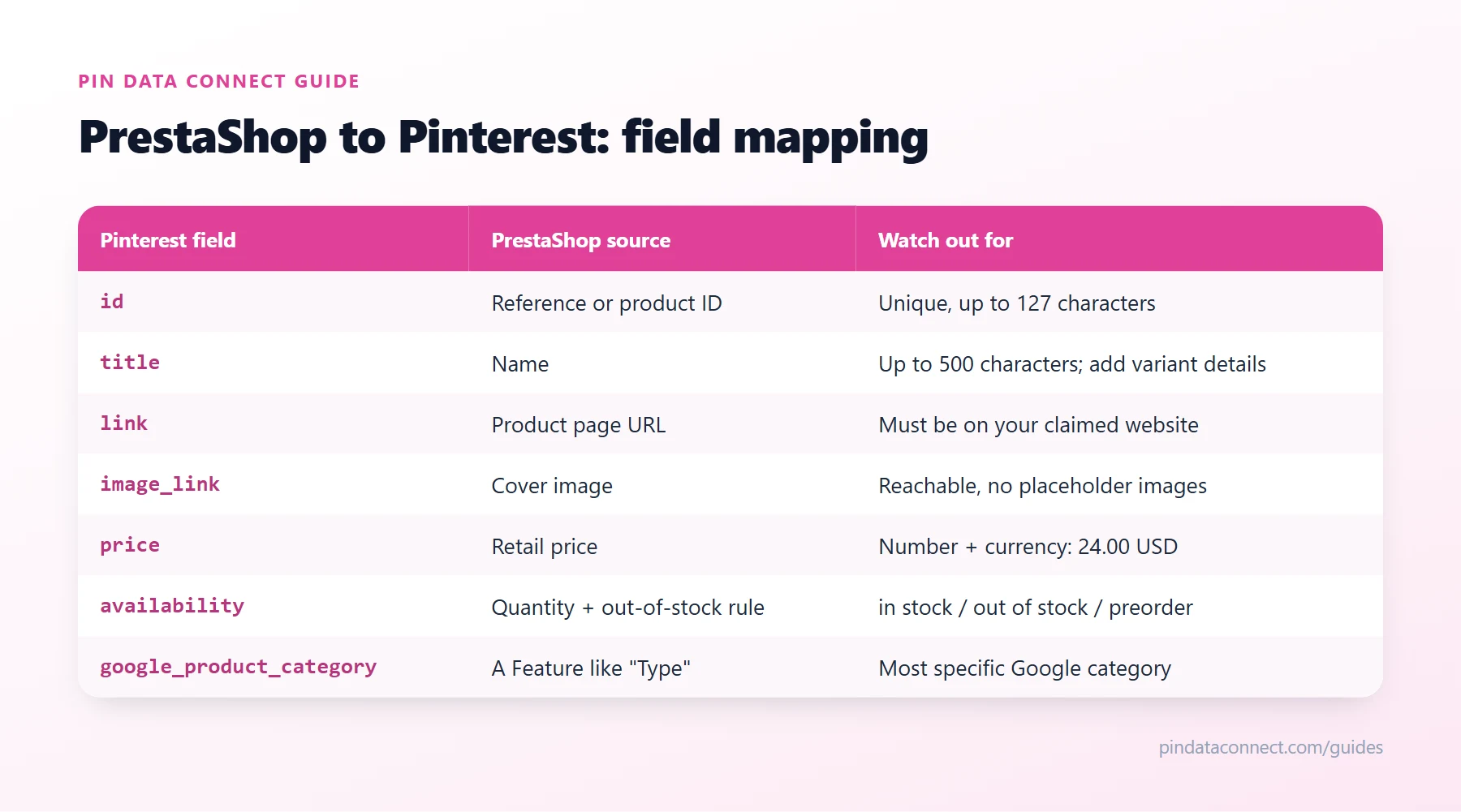
The table above shows where each Pinterest field comes from in your Presta catalog. A few PrestaShop details need extra care:
- Product type: PrestaShop categories are usually broad shopping groups ("Home", "Sale", "Gifts"), not what the product actually is. A Feature such as Type ("Mug", "T-shirt") is a far better source for a category.
- Combinations: sizes and colors in PrestaShop are combinations. Listing each one separately means grouping them under one
item_group_id- check whether your module or connector supports combinations, or whether it lists one item per product. - GTIN and MPN: PrestaShop has EAN-13 and UPC fields for barcodes, and the Reference field works as an MPN.
- Language and tax: multilingual shops store a name and description per language, so use the language of the country you're selling to. Prices should include or exclude tax the way Pinterest expects for that country.
Step by step
- Get your Pinterest account ready - see "What Pinterest needs" above.
- Create a read-only Webservice key. In your PrestaShop back office, go to Advanced Parameters > Webservice, make sure the webservice is enabled, and choose Add new webservice key. Generate the key and give it View (GET) permission only, on products and the resources your feed reads, such as categories and product features.
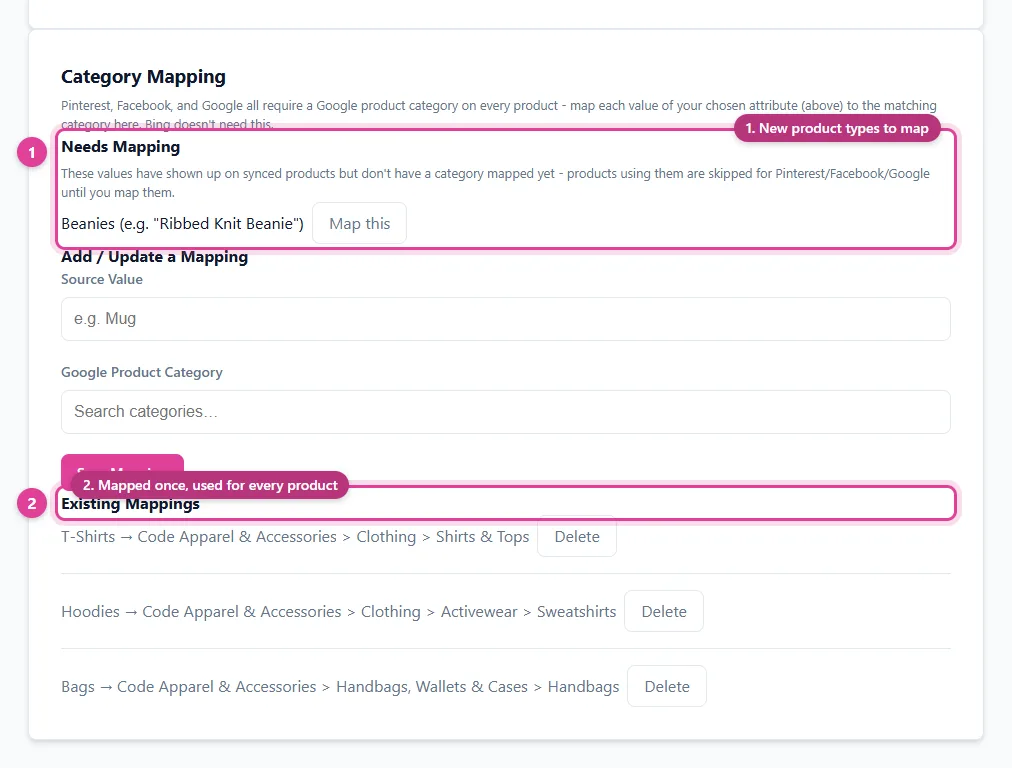
- Map your product types to Google product categories. Pinterest needs to know what each product is. Map each value of your Feature (like "Type") to one category from the Google product category list once, and every product with that value is categorized from then on.
- Add the data source in Pinterest. In Pinterest Business, open Catalogs, add a data source, and paste your feed URL (with its username and password if it's protected). Pinterest checks it, then re-reads it about once a day.
- Check the first import. Review the errors Pinterest reports and fix them in PrestaShop, not in the feed - your store stays the single source of truth.
Common PrestaShop to Pinterest problems
- Product links that don't open. If friendly URLs are off, or a product is disabled or not visible in the catalog, its page may not load for a shopper - and every product's
linkhas to. - Images Pinterest can't download. Use a cover image on every product, and make sure your image URLs load in a logged-out browser.
- "Domain not claimed" or links rejected. Claim the exact domain your product pages use, including whether it has www.
- Products missing after an upload. Check the data source's errors in Pinterest - How to Fix Pinterest Catalog Errors covers each one.
Related guides
For more on Pinterest itself, see What Is a Pinterest Catalog?. Running a WooCommerce catalog instead of a Presta catalog? WooCommerce to Pinterest covers the same setup for WooCommerce.
Frequently asked questions
Can I connect PrestaShop to Pinterest without a plugin?
Yes. Pinterest reads a product feed, so you can build one from your PrestaShop products yourself or use a connector that reads your store through its API and hosts the feed at a URL Pinterest fetches on a schedule - nothing to install on your site.
Is there an official PrestaShop Pinterest module?
No. There is no official Pinterest catalog module from PrestaShop or Pinterest, so PrestaShop stores use third-party modules or a feed tool that builds a Pinterest data source from their products.
Do PrestaShop combinations sync to Pinterest?
Only if your module or connector supports them. Each combination needs its own listing grouped under one item_group_id. Some tools, Pin Data Connect's connector included for now, list each PrestaShop product as a single item instead.
How often does Pinterest update my PrestaShop products?
It depends on both sides: a PrestaShop connector refreshes when it checks your store or when you click to sync, and Pinterest re-reads a hosted data source about once every 24 hours. A hosted feed URL means you never re-upload anything.
Do I need to claim my website on Pinterest?
Yes. Pinterest catalogs only accept products whose link is on a website you have claimed in your Pinterest business account, so claim your store domain before adding the data source.
Connect PrestaShop to Pinterest - and three more platforms
Pin Data Connect's Store Product Catalog Connector reads your Presta catalog with a read-only Webservice key and builds your Pinterest catalog for you - refreshed with one click of Sync Now - with Pinterest, Facebook, Google, and Bing all in one subscription.
See the Store Product Catalog Connector →
Save this guide for later
Pin it to one of your Pinterest boards so it's easy to find when you're ready to set things up.
Save to Pinterest